

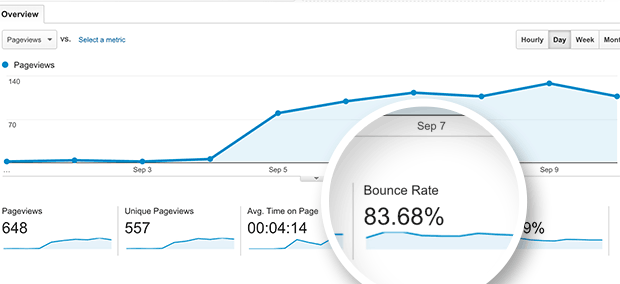
If you’re like most website owners, you spend a lot of time and effort driving traffic to your website only to see them bounce away in mere seconds. It’s hard to come to terms with. After all, you love your website, so why doesn’t everybody else? While some of the bounce rate of your site is simply from people landing on your page mistakenly or getting distracted from other things, there are some ways you can improve the stickiness of your site and keep people there once they arrive. Accepting that your site has a high bounce rate is a little like accepting that maybe, just maybe, your child isn’t the best-looking kid in the school photos. Sure, you think your precious little angel is just adorable (and just so we’re clear, we’re talking about your website now), yet when you head into Google Analytics to check the numbers, your bounce rate tells a different story.
A high bounce rate doesn’t necessarily mean visitors aren’t reading your content, though. Google defines bounce rate by how many actions the user takes after landing on a page. If someone lands on a page but takes no other action than reading that page, the bounce rate appears high. Your fans may read a full article but not take action. You must also compare your bounce rate to the average number of seconds on your page.
How low should your bounce rate be? It depends on your goals for your landing pages. If you only want visitors to read your content and not take another action, then a higher bounce rate is acceptable. However, if the goal is converting visitors into customers or subscribers, the bounce rate goalpost is lower. Some sites might view a bounce rate of 80% as awesome, whereas other sites might see this as nothing short of catastrophic. It really depends on your site and business goals.

Now that you understand the underlying triggers for bounce rate, here are some reliable ways of lowering your page’s bounce rate:
Optimize Page Load Time
Many marketers assume that if their bounce rate is high, the issue must lie with a page’s content – when, in fact, serious problems can arise before a user even has the chance to read a page at all.
Of all the problems a web page can have, taking forever to load is arguably the worst. After all, it doesn’t matter how good or bad a page’s content is if a user can’t read it (or even see it), and 47% of users expect a web page to load in two seconds or less, making on-page optimisation crucial to reducing your bounce rate.
This is especially true for mobile sites. According to data from Radware, a connection speed delay of just 500 milliseconds can result in an increase in “peak frustration” of more than 26%, and a decrease in engagement of 8%.
Further, slow-loading pages are among the leading causes of shopping cart abandonment for ecommerce retailers. Amazingly, only 2% of the world’s leading 100 ecommerce websites have mobile sites that load fully in less than five seconds on mobile devices – and one-fifth take almost eight seconds to load completely, an almost criminally long time for sites that live and die by conversion rate optimisation.
Before you even think of looking at the content of your pages, make sure your visitors can actually view them in a reasonable amount of time.
Focus on the People
Since your bounce rate reflects people’s reaction to your page, your first step toward improving bounce rate is knowing your audience. Once you understand what the people who visit your page want, you can revamp your page to meet their expectations.
Create a buyer persona – or several – based on what you know about your current site visitors. Utilise Google Analytics, backend web traffic patterns and polls of your existing customers. Putting a name and a face to a pretend customer allows you to filter everything you do through the lens of how that person might view your website and your brand.
Cross-Reference Bounce Rate with Time on Site
As the old saying goes, “No metric is an island” (or something like that), and taking bounce rate data out of context can be as dangerous as relying on it exclusively as an indicator of your site’s performance.
It’s important to look at your bounce rate within the wider context of your site in general. Doing so allows you to ascertain more accurately whether the problem is with a specific page, a type of page (such as your site’s blog or product pages), or your site as a whole. If your Time on Site metrics are decent, but your blog pages have a high bounce rate, the problem may be with your content. On the other hand, if your bounce rate is high and Time on Site is low, you may not be giving visitors what they want in a more general sense.
As with any metric, be sure to investigate usage trends with wider site data to make sure you’re not dealing with an anomalous outlier of a page when making decisions that will affect your whole site, or that you’re not missing a larger problem by focusing too narrowly on the details.
Make a Beautiful Landing Page
The aesthetics of your site matter. You have a few seconds to make an excellent first impression on site visitors. Your site should look professional and uncluttered. Researchers discovered 94 percent of the negative feedback sites received related to the design of the website. Elements such as user-friendliness and the attractiveness of your website all play into the first impression you make.
If you’re unsure about the appearance of your landing page, ask for feedback from your regular customers and make changes, conducting A/B split testing as you go until you have an aesthetically pleasing page. You can also hire a designer to tweak the design you already have.
Highlight Special Offers
Entice new customers into trying out your e-commerce store by offering special discounts, free shipping and highlighting items on sale. If a site visitor spots something that interests them at a great price, they may be more likely to become first-time customers. Sales are also an excellent way of clearing out inventory on items moving slow.
Consider offering a discount code to new customers if they sign up for your mailing list. Even a small discount gives them a better deal and entices them to take a chance on you, but it also collects their email so you can market to them at a later date. Set up cart abandonment procedures where you email the person and remind them of the item in their cart and offer free shipping or a discount if they complete the order.
Ruthlessly Optimize for Relevance
Aside from technical considerations like page load times or failing to adhere to formatting best practices, one of the biggest contributing factors to high bounce rates is relevance – or irrelevance.
Some sites target certain keywords very effectively, only to serve content that is tangentially relevant to that query at best, or downright irrelevant to it at worst. If the page you’re serving isn’t directly relevant to a user’s query, you can almost guarantee that they’re going to bounce. For this reason, it’s vital that you optimize for relevance above all other considerations.
If you decide to go after a keyword, and end up ranking for it, make sure the content of the page you serve is highly relevant to that query. Consider user intent when targeting keywords. Is the prospect looking to learn something, or buy something? What stage of the funnel are they in? What problem are they trying to solve? These are all questions that can help you provide the most useful, relevant content to your audience, and the more relevant your content is to users’ queries, the more likely they are to stick around once they’ve arrived on your site.
Improve Readability
Have you ever visited a website that was one large chunk of body text? A big block of words is hard to read on a PC, but particularly difficult to comprehend on a mobile device, which many people now use for accessing the Internet.
Break up your text with <h1><h2>, and <h3> headers as well as bullet points and shorter paragraphs. We’ll talk more about images below, but images also play a role in creating a break from huge chunks of text.

Lose the Pop-Ups
Pop-Ups annoy site visitors and aren’t very effective at converting people into customers. Only 14 percent of site visitors even consider responding to a pop-up ad at all. If you must use a pop-up, make sure it is a fantastic offer and use it to convert visitors into subscribers and you must consider the pop-up impact on mobile experience!
Pop-Ups should be easy to exit out of by clicking a close button, an X or by clicking on the main part of the website page. If visitors can’t get the pop-up to go away easily, they very well may bounce away from your site altogether and head to a competitor without annoying pop-ups.
Change Your Call to Action (CTA)
Your call to action (CTA) needs to be in a spot that’s obvious to users. The goal of a CTA is getting your site visitors to take a specific action. If you can make the button more personalized to a particular buyer persona, it will perform as much as 202 percent better.
The study found that smart CTAs, when targeted to individuals based on elements such as location, language or previous visits performed best. Keep your CTA personal, short and filled with action words.
Your CTA needs to contrast with the rest of the page, so it stands out and draws the visitor’s eye. It should also be short and to the point.
Tell a Story
People are inundated with marketing every day. They hear ads on the radio, see billboard ads, get inboxed with marketing offers and see even more advertising on social media. If you want to grab the average person’s attention, you need a way to rise above all the noise from other companies.
Storytelling is one way of grabbing user’s attention and keeping it, but how does storytelling work? For example, if you want to explain to your consumers their need for a new filter in their furnace every month, you might start by talking about a customer who forgot to change their filter and the issues they had and then go from there. A story makes your content more relatable.

Make Your Site Easy to Search
Even in 2019, site search functionality is one aspect of the Web that seems to have remained largely unchanged since the migraine-inducing days of Geocities sites. For whatever reason, site search is considered an afterthought by many websites, representing a huge missed opportunity to provide your visitors with the tools they need to find what they want and reduce your bounce rates.
Even the most accurate, relevant content recommendations still put the ball firmly in your court in terms of control. Site search, on the other hand, allows visitors to find what they want, not what you think they want. If you’ve ever tried to search a site only to be presented with a “Page Not Found” or “No Results” page for a search query that should have offered dozens of results, you know how needlessly frustrating this can be.
Ok, so your site’s search functionality will probably never be as good as Google, but that doesn’t mean you should overlook or ignore it, either. The more easily users can search for and find what they’re looking for, the more likely they are to stick around.
Update Frequently
One reason for a high bounce rate could be lack of changing content. If a site visitor comes back to your site and sees the same material that was there a month ago, they may bounce away never to return. Update your content frequently and keep your page fresh.
Adding new content, such as through a blog or offering videos and infographics also gives you something to share on social media and shows search engines your site is current and active.
Go Mobile First
It’s a little sad that we have to reiterate how important this is, but the number of websites that still aren’t optimized for mobile is breathtaking. With the number of users accessing the Web primarily from mobile devices increasing every year, failing to optimize your site for mobile is practically begging for users to bounce and take their business elsewhere. Internet access via mobile phones is around 63.4 percent currently and rising steadily year after year. People get on their smartphones during any downtime. If your site isn’t ready for mobile visitors, you’ll end up with a higher bounce rate.
Have you ever visited a site via a mobile device that had tiny text or huge text and the layout was crazy? That site wasn’t mobile responsive and more than likely you grew frustrated and bounced away.
It’s also vitally important to remember tip #1 when optimizing your site for mobile. It doesn’t matter how pretty your site looks on an iPhone if it takes more than a minute to load.

Make Your Site’s Navigation Effortless
In the simplest (though perhaps harshest) terms, you can think of your site visitors as lazy, entitled, spoiled little snowflakes that want everything spoon-fed to them with minimal effort. This might not be the most pleasant way to imagine your audience, but let’s be honest – if you force your users to do even the slightest bit of work to get what they want, they’ll simply go to another site. For this reason, it’s crucial that your site navigation be as effortless as it possibly can be.
Picture a typical browsing session on your site from the perspective of a user. They arrive at your site, and after evaluating your content for a second or two – and oftentimes that’s literally all the time you have – they decide that although this page isn’t precisely what they’re looking for, your site could potentially give them what they want. They then attempt to locate the page they are looking for, only to find that your navigation is hidden behind illogical animated drop-down menus, or image links that don’t look like image links, or some similarly atrocious navigational horrors.
Your site navigation should be clear, immediately understood, and offer the user a seamless experience in getting from one part of your site to another. Visitors shouldn’t have to guess where they are in your site to know how to get around, and they shouldn’t be forced into artificial pathways that you’ve put in place to shepherd them through your sales funnel. Remember – they’re in control, not you.
Becoming Sticky
Your goal for your pages should be to create sticky pages visitors want to stay on and focusing on the action you’d like them to take. A high bounce rate doesn’t necessarily mean your page isn’t effective, but it might say you need to put more focus on your conversion funnel and tweak elements on your page.
A bounce rate is quite complex and many different elements on your website play into your final numbers. Look at your bounce rate alongside time spent on page as well as your overall goals for your site. Your bounce rate might not be the lowest in the industry, depending on personal goals, but anyone can improve bounce rate with minor effort.

It’s not all clear….Let’s look at the problems with bounce rate
Alongside Bounce Rate, you’ve probably noticed the Time on Page metric in Google Analytics. This, as its name implies, is an estimate of how long on average users spend on a given page. The reason Time on Page is an approximated metric, rather than a clearly defined measurement, is because Google Analytics (and other analytics platforms) requires two clicks to accurately calculate Time on Page; an “entrance” click – typically the link click that brings a user to a page in the first place – and an “exit” click, usually a click on a navigational element that takes them away from a page.
Unfortunately, this crucial exit click is often missing from the equation. Ever spent a few minutes reading a page before closing the tab (or the browser)? If so, Google Analytics couldn’t accurately measure the Time on Page because it missed that vital exit click during that particular session. In this example, it doesn’t matter if a user clicked onto a page, read every single last word of an 8,000-word blog post, and left entirely satisfied – if they closed the tab without exit clicking, that session is logged as a bounce. The same goes for sessions in which a user opens a link in another tab and leaves the original tab open before eventually closing their browser.


